

About This Research Material
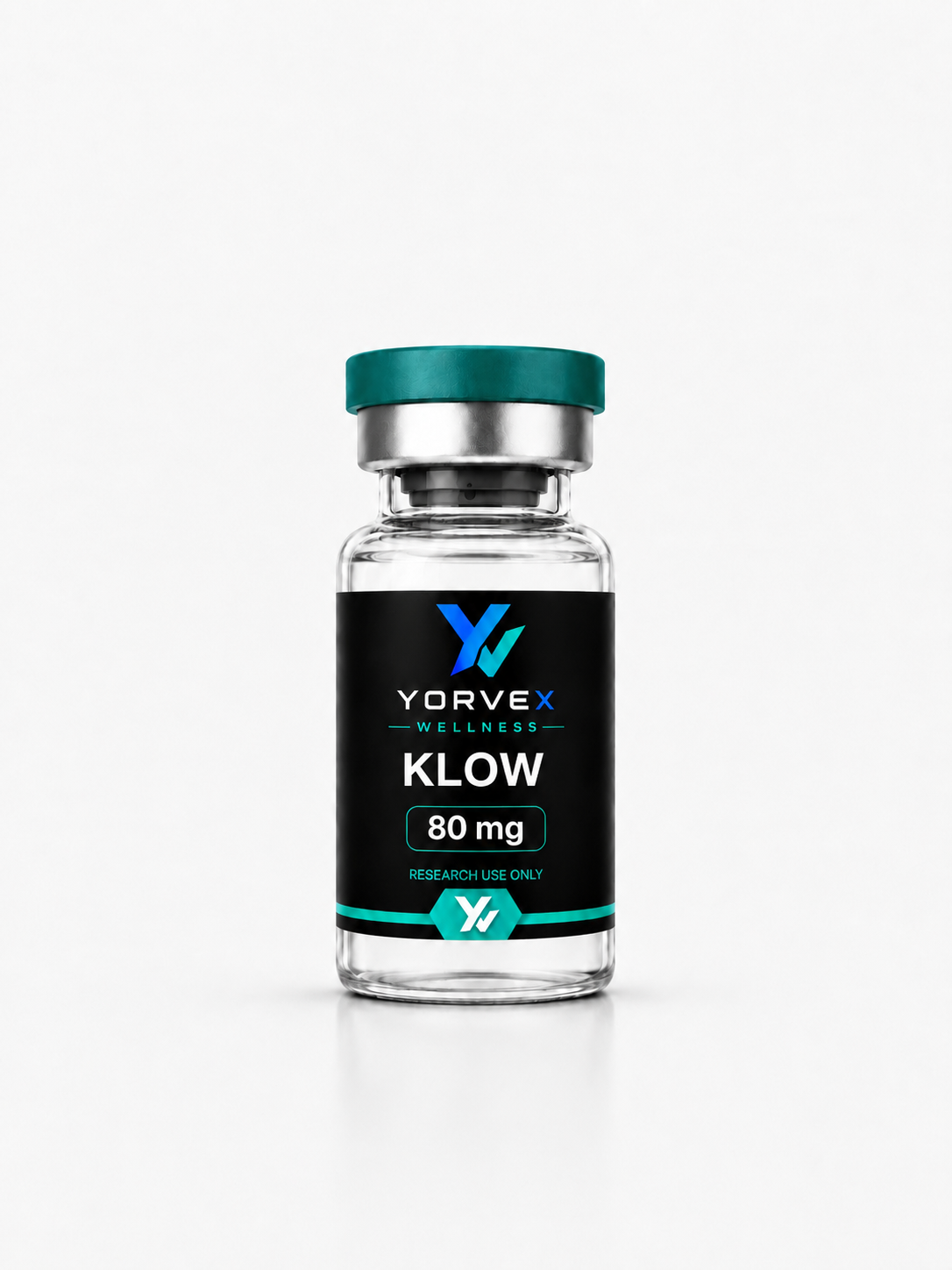
Klow is supplied as a proprietary multi-component research peptide preparation, delivered as a single lyophilized (freeze-dried) 80 mg reference material for in-vitro and preclinical laboratory work only. Rather than a single sequence, it is a combined preparation in which several skin-model research peptides are co-formulated and co-lyophilized in one vial at a defined ratio. This combined format is the defining characteristic that laboratories account for when planning identity checks, reconstitution, and assay design: a blend is treated as a mixture with its own analytical fingerprint, not as an isolated single-peptide standard. The material is categorized here for skin-model and matrix-biology research, and all descriptions below concern the research substance itself — its component makeup, its documented study context, and standard handling of lyophilized peptide reference material — and are not statements about outcomes in humans or animals.
Proprietary skin-model research blends of this type typically pair a copper-coordinated peptide component with one or more matrix-signaling peptide sequences frequently cited in extracellular-matrix and dermal-fibroblast literature. Because the exact component identities and stoichiometry are proprietary to the preparation, researchers evaluating Klow are encouraged to work from the batch-specific certificate of analysis for the definitive component and purity breakdown rather than assuming a fixed composition. The combined preparation is intended for investigators studying multi-sequence matrix-model interactions under controlled bench conditions.
What Has Been Studied
There is no clinical literature specific to a proprietary blend under this trade name; the relevant research context is the in-vitro and preclinical work on the individual peptide classes that such skin-model research preparations draw from. The summaries below describe observations in laboratory models for those component classes generally, are hypothesis-generating, and remain preliminary and ongoing rather than settled. They are not statements about the blend’s effects in people or animals.
- Copper-peptide chemistry: physical and coordination studies on copper-complexed peptide components have quantified copper-binding behavior and complex stability, and have examined concentration-dependent extracellular-matrix and antioxidant-response gene expression in fibroblast and skin-model cell cultures in vitro.
- Matrix-signaling peptides: matrix-signaling sequences of the kind used in these blends have been examined in cell-culture and tissue-model systems for their reported roles in collagen-associated and matrix-remodeling signaling under experimental conditions.
- Blend-formulation and interaction research: analytical work characterizes how co-formulated peptides behave together across buffer systems, including whether component peptides remain independently resolvable and stable when combined in a single lyophilized matrix.
- Comparative characterization: benchtop studies compare the chromatographic and mass-spectrometric behavior of the mixture against its isolated single-peptide reference standards to confirm each component is present as expected.
Research Context
Findings referenced here derive from isolated-cell, tissue-model, and coordination-chemistry studies of the individual peptide classes, not from studies of this specific proprietary blend. They are hypothesis-generating, have not been established as clinical outcomes, and are provided as neutral scientific background — not medical advice or any claim of safety or efficacy.
Analytical Characterization
For a multi-component preparation, analytical verification is more involved than for a single peptide because each component must be confirmed and, ideally, resolved. Reversed-phase HPLC is typically used to profile the mixture and quantify the purity of each resolvable peak, while mass spectrometry confirms the molecular identity of the individual component sequences by their expected masses. Where a component is a copper-coordinated peptide, its altered retention and ionization relative to a metal-free peptide are documented separately, so reviewers can confirm the copper-complexed species is present as intended rather than an unbound form.
A batch-specific certificate of analysis (COA) for Klow generally reports the HPLC profile and per-component identity confirmation by mass spectrometry, and may include water content or residual-solvent data for the lyophilized powder. Because component ratio, purity, and lot-to-lot variation are more consequential in a blend than in a single-sequence standard, laboratories are strongly encouraged to review the lot-specific COA rather than a generic specification, and to archive it alongside experimental records to support traceability and reproducibility.
Laboratory Handling
The following describes conventional handling of lyophilized research peptides and is not instruction for human or animal use. Sealed Klow powder is kept protected from light, humidity, and heat. Because copper-coordinated peptide components can be redox-sensitive, exposure to light and oxidizing conditions is minimized and solvent choice is documented per protocol, since certain buffer components can interact with a copper center. Reconstituted and working solutions are prepared fresh where possible and handled under the temperature conditions shown in the storage specifications on this page and in accordance with institutional safety requirements.
Reviews
There are no reviews yet.