

About This Research Material
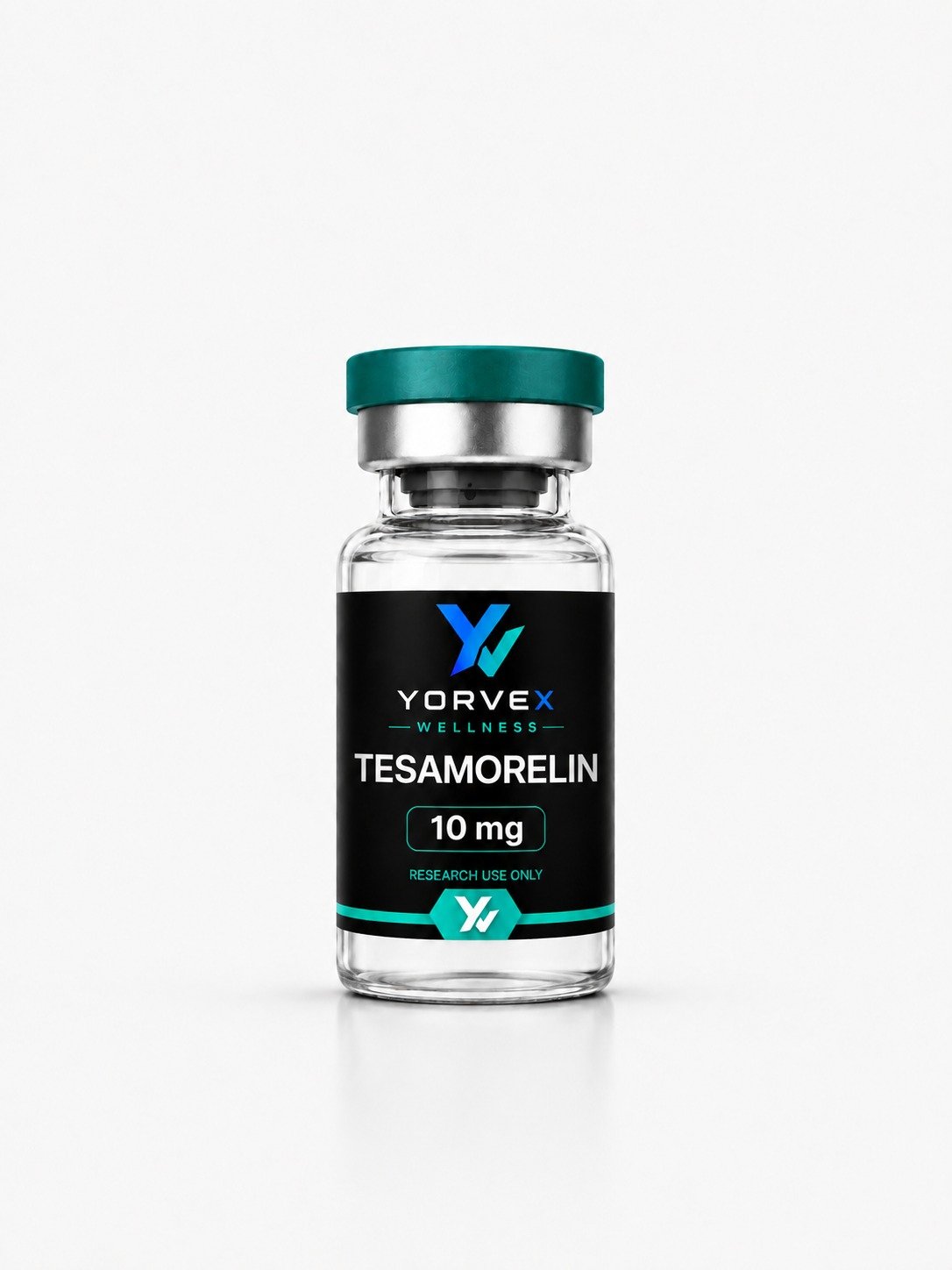
Tesamorelin is a synthetic analog of human growth-hormone-releasing hormone (GHRH), supplied here as a 10 mg lyophilized (freeze-dried) research peptide for in-vitro and preclinical laboratory work only. Structurally it is a stabilized 44-residue peptide corresponding to the full-length GHRH(1-44) sequence, distinguished from native GHRH by an N-terminal trans-3-hexenoyl (unsaturated fatty-acid) modification. This acylation is the defining feature of the molecule in the research literature: it hinders recognition by dipeptidyl peptidase-IV (DPP-IV), the enzyme that rapidly clips the N-terminus of unmodified GHRH, and thereby extends the peptide’s measurable half-life in experimental systems. Investigators frequently reference the compound by its development code TH9507.
As a GHRH-receptor agonist, Tesamorelin is studied in laboratory settings as a tool compound for probing the somatotroph axis at the level of the pituitary GHRH receptor, rather than as a direct agonist of the growth-hormone receptor itself. This mechanistic position, upstream at a G-protein-coupled receptor, is part of why it appears in receptor-pharmacology and secretagogue research alongside shorter fragments such as GHRH(1-29). The material offered on this page is intended solely as a characterized reference compound for that kind of controlled, benchtop investigation.
What Has Been Studied
The preclinical and in-vitro literature surrounding Tesamorelin centers on its interaction with the GHRH receptor and on the pharmacological consequences of its enzymatic stabilization. Reported research themes include the following, described strictly as observations in laboratory models rather than as outcomes in humans:
- Receptor-agonism studies: cell-based assays measuring GHRH-receptor engagement and downstream cyclic-AMP signaling in cultured pituitary-derived or receptor-transfected cell lines.
- Enzymatic stability comparisons: in-vitro work contrasting the degradation of the trans-3-hexenoyl-modified peptide with native GHRH in the presence of DPP-IV and serum, used to characterize the structural basis of its extended half-life.
- Secretagogue-axis modeling: preclinical model systems in which GHRH analogs are used as pharmacological probes of pulsatile somatotroph signaling.
- Analytical and formulation research: stability profiling of the lyophilized peptide across buffer systems and reconstitution conditions relevant to assay design.
Because experimental parameters such as cell type, receptor construct, concentration range, and endpoint differ substantially between reports, cross-study generalization is not supported by the current data. This research is preliminary and ongoing, and the information here is educational only and not medical advice. Researchers reviewing this literature typically treat it as mechanistic and hypothesis-generating. Observations in isolated cells or animal models do not establish results in other biological systems, and this material is not a therapeutic product.
Analytical Characterization
For a 44-residue peptide bearing an N-terminal acyl modification, analytical verification is central to reproducible results, because both sequence fidelity and correct modification must be confirmed. Research-grade Tesamorelin is typically assessed by reversed-phase high-performance liquid chromatography (RP-HPLC) to quantify chromatographic purity, usually reported as the percentage of the main peak. Mass spectrometry (commonly ESI-MS or MALDI-TOF) is used to confirm that the measured molecular mass matches the expected value for the modified 44-mer, verifying both identity and the presence of the trans-3-hexenoyl group rather than the unmodified backbone.
A lot-specific Certificate of Analysis (COA) documents these analyses. Researchers evaluating a batch generally review the reported HPLC purity value and chromatogram, the mass-spectrometry identity confirmation, and the net peptide content, since counter-ion (typically acetate) and residual water in a lyophilized powder mean the peptide mass in a given vial can differ from the gross fill weight. Confirming these figures against a current, lot-matched COA before use is standard practice and directly affects the accuracy of experimental concentrations.
Standard laboratory handling: the lyophilized powder is generally kept sealed, cold, and protected from light and moisture, with long-term storage of dry peptide commonly at -20 C or lower. Reconstituted solutions of a peptide of this length are less stable than the freeze-dried form and are typically kept cold and used within a limited, empirically confirmed window. These are material-handling notes for laboratory use only and do not imply any human or animal use.
Robert –
exelente producto me a ayudado mucho en mi rutina de gym diaria love it